July 25, 2025
A new start for mitophagy
The recycling of damaged or surplus organelles by autophagy is crucial to maintaining cellular fitness. Dysregulation of mitophagy, in particular, is linked to Parkinson’s disease. A new study by postdoc Elias Adriaenssens from the lab of Sascha Martens at the Max Perutz Labs reveals a new mechanism for mitophagy initiation – showing that conventional downstream autophagy proteins, specifically WIPI proteins, are sometimes required in the early steps of autophagosome biogenesis. The discovery provokes a reconsideration of the hierarchy of factors in autophagy initiation. The study is part of the ‘Aligning Science Across Parkinson’s (ASAP)’ scientific collaboration network and is now published in Nature Cell Biology.
Defects in mitophagy – the selective degradation of mitochondria – are implicated in the development of Parkinson’s disease (PD). For years, research has focused almost exclusively on the PINK1/Parkin pathway, which drives mitophagy upon mitochondrial membrane depolarization. However, recent findings highlight the importance of alternative pathways involving transmembrane mitophagy receptors, which operate independently of the ubiquitin-driven recruitment mediated by PINK1 and Parkin. These membrane-bound receptors are embedded in the mitochondrial outer membrane and facilitate mitophagy in response to different cellular conditions. Exploring how these parallel pathways function and are regulated has been a key focus of the Martens lab, led by postdoctoral researcher Elias Adriaenssens.
Read the full news in the Max Perutz Labs News here.
Publication:
Reconstitution of BNIP3/NIX-mitophagy initiation reveals hierarchical flexibility of the autophagy machinery.
DOI: 10.1038/s41556-025-01712-y
Authors:
Elias Adriaenssens, Stefan Schaar, Annan S. I. Cook, Jan F. M. Stuke, Justyna Sawa-Makarska, Thanh Ngoc Nguyen, Xuefeng Ren, Martina Schuschnig, Julia Romanov, Grace Khuu, Louise Uoselis, Michael Lazarou, Gerhard Hummer, James H. Hurley & Sascha Martens.
Read an article about the study here in the University of Vienna’s magazine Rudolphina (in German)
Watch an interview here with group leader Sascha Martens about the study (in German)
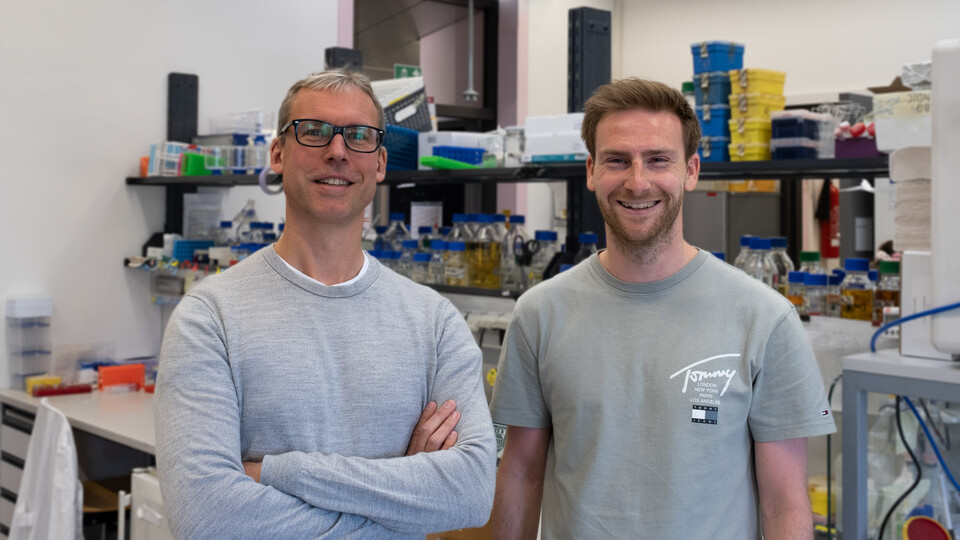
Group leader Sascha Martens (left) and first author Elias Adriaenssens (right). © Max Perutz Labs